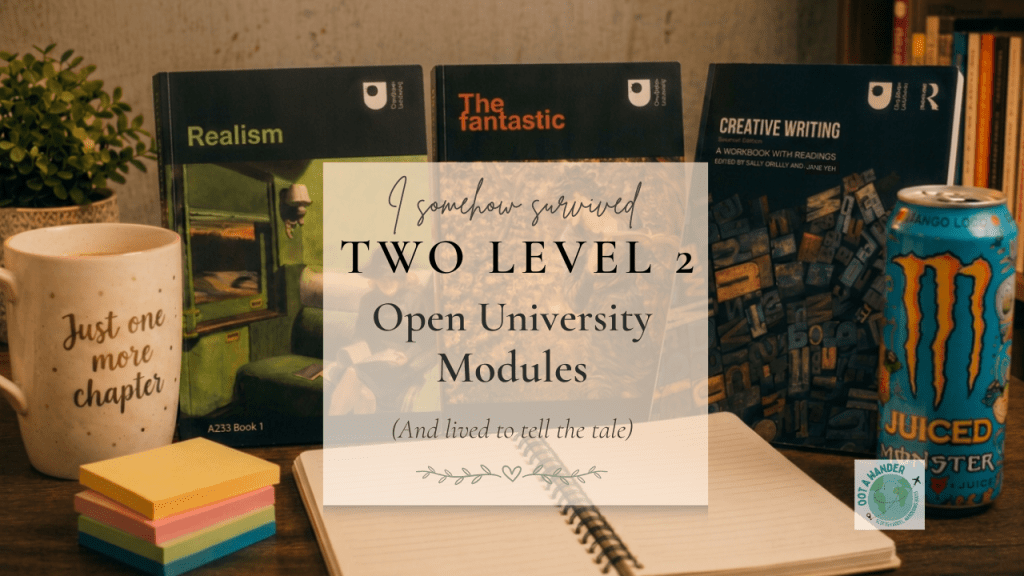
If you’d asked me this time last year how I thought second year at the Open University was going to go, I’d probably have laughed nervously while surrounded by approximately seventeen notebooks, enough energy drink to knock someone out in a sugar rush and a laptop with forty-seven tabs open (it is usually much more than that).
I’m still not entirely convinced it wasn’t some sort of fever dream.
Level 2 has a bit of a reputation. Before I started, everyone seemed to describe it as the year. The year where the difficulty ramps up. A massive step up from Level 1. The year where people start doubting themselves. The year where you realise that maybe you actually don’t know how to write an essay after all.
Naturally, I convinced myself I was about to fail spectacularly.
Spoiler alert…

I didn’t.
It was challenging, absolutely. There were moments where I questioned myself, stared blankly at my laptop and became convinced I’d somehow forgotten how to write an essay or how to spell the word ‘orange’. There were plenty of late nights, more empty cans of mango Monster than I’d care to admit, and at least a few occasions where I promised myself I’d definitely start the next assignment earlier.
Reader… I rarely did.
Looking back though, I wouldn’t change it. Stress seems to be where I thrive.
The jump from Level 1 is real
Nobody was lying. The jump is noticeable.
It’s not that the work suddenly becomes impossible. It’s that you’re expected to think differently. At Level 1, you’re learning how university works. You’re building confidence. You’re finding your feet. Dusting off your brain if it has been a while since you were in education.
Level 2 removes the stabilisers… and then politely shoves you down a very large hill.
You’re expected to analyse more deeply. Think more independently. Read more critically. Make stronger arguments. Back everything up. Then somehow fit it all into the word count (that is never enough!) without sounding like you’re trying too hard.
It can feel overwhelming at first.
I remember opening some of the early materials and thinking, Oh… this is proper university now.
But… you’ve already been doing the work. You already know how to reference, how TMAs work, how to study independently and how to juggle deadlines. Level 2 isn’t starting from scratch; it’s asking you to build on foundations you’ve already laid.
There were weeks I genuinely questioned myself
I’m quite good at convincing myself I’m terrible at things.
I’d submit a TMA feeling reasonably confident, then spend the next few days remembering every sentence I’d written and deciding it was complete nonsense. And should I just scrap that submission and start again?
I’d read discussions from other students and wonder if everyone else had secretly understood something I hadn’t.
I’d overthink tutor comments.
I’d rewrite paragraphs that were perfectly fine because suddenly I’d decided one adjective wasn’t quite right.
If that sounds familiar, welcome to the club.
I don’t think imposter syndrome ever completely disappears. It just shrinks as you keep proving yourself wrong.
A215 – Creative Writing
Out of the two modules, A215 was the one I was most excited about. Creative writing is the reason I started this degree in the first place, so finally getting stuck into short fiction, poetry (I’m not a fan tbh) and life writing felt like opening the door to everything I’d been looking forward to.
It also pushed me well outside my comfort zone.
Some activities came naturally, while others had me wondering if everyone else had secretly been born knowing how to write dialogue or poetry. The beauty of creative writing, though, is that there isn’t one right answer. Every student could take the same prompt in a completely different direction, and that was something I really came to appreciate.
If you’re about to start A215, my biggest piece of advice is this: don’t wait for the perfect idea.
It doesn’t exist.
Write the messy draft. Let it be clunky. Let it wander off on tangents. Let it be completely different from what you imagined. Most of my assignments changed dramatically between the first draft and the version I eventually submitted, and that’s exactly what the editing process is for. And you will come to be best friends with editing, ‘killing your darlings,’ and saving drafts (TIP: name the file properly!).
I’d also recommend keeping every exercise you do throughout the module, even the ones you’re convinced are terrible. More than once, I found myself flicking back through old notebook pages and discovering an idea, a sentence or a character that suddenly fitted perfectly somewhere else.
A233 – Telling Stories: The Novel and Beyond
If A215 let me create stories, A233 taught me to look at them differently.
There’s a lot of reading.
Actually… there’s a lot of reading.
The module explores novels and storytelling in ways I’d never really thought about before. It isn’t just about whether you enjoyed a book or how quickly you read it. It’s about why the author made certain choices, how narratives are constructed, how different readers interpret the same text and what those stories tell us about the world around us.
Some books completely pulled me in. I was so taken and in tears over Mrs Death Misses Death by Salena Godden that I completely forgot that I had to write an assignment on it. It is one book that I can see myself rereading for its wisdom in how it makes me view Death, and Life.
Others… let’s just say we didn’t become best friends.
But that’s part of studying literature. You don’t have to love every text to learn from it. In fact, some of the books I enjoyed the least ended up giving me the most interesting things to write about.
One thing I learned very quickly was to make notes while I was reading. Colour-coded sticky tabs in my notebook, highlights in certain colours meant different things, and to not be scared of marking a book!
Every time I thought, ‘I’ll remember where that quote was,’ I absolutely did not remember where that quote was. I had to stop kidding myself.
A page number scribbled in my notebook saved me hours when it came to writing TMAs.
The tutor rollercoaster
One thing I definitely wasn’t expecting this year was the tutor rollercoaster.
When you study with the Open University, your tutor becomes your main point of contact. They’re the person marking your assignments, giving you feedback, answering your questions and reassuring you that you’re not completely losing the plot (pun intended).
So naturally, I assumed I’d have one tutor for each module from beginning to end.
Instead, life had other plans.

Over the course of the year, there were illnesses, tutor changes and handovers. I had the same tutor for both modules, so it was double the changes. Just as I’d got used to one tutor’s style of feedback, someone else would step in. Every tutor had their own way of explaining things and their own areas of focus, so there were moments where it felt like I was constantly adjusting. Being neurospicy, I found this particularly challenging because I’d only just settled into one tutor’s way of giving feedback before everything changed again.
When you’re already trying to build confidence in your own writing, changing tutors can feel like starting all over again.
Looking back though, I think it taught me something I probably wouldn’t have learned otherwise.
Good feedback is good feedback, regardless of who gives it.
I stopped trying to write what I thought one particular tutor wanted to read and started focusing on writing the strongest assignment I could. The marking criteria hadn’t changed, even if the person reading my work had.
It also reminded me that tutors are human. Life happens. People become unwell. Unexpected situations arise, and sometimes everyone has to adapt and go with the flow.
Although it wasn’t the year I’d expected, I genuinely think it made me a more independent student.
To every tutor who read my work this year over both modules, thank you. Every comment, every suggestion and every little bit of encouragement helped me grow as both a student and a writer, and I’m incredibly grateful for the time you invested in helping me improve.
What Level 2 really taught me
When I started this year, I thought I was going to learn how to write better.
I did.
But I also learned that confidence doesn’t come before you begin.
It comes afterwards.
It sneaks up on you a bit, somewhere between your first assignment and your last. Somewhere between the moment you stare at a blank document wondering if you belong here and the moment you realise you’re analysing texts without even thinking about it. Even in a bookshop, flicking through books ‘for fun’ that you know will just go on your TBR pile.
I also discovered that perfection is an awful study strategy.
Some of my best assignments started life as absolute word soup.
Some study sessions lasted for hours of intense focus, surrounded by snacks, Monster, and anime soundtracks blasting in my ears.
Others consisted of twenty minutes with a cup of green tea before life interrupted again.
It all counted. It was all study time. Reading counted. Highlighting counted. Thinking counted. Staring out the window trying to untangle an essay argument probably counted too.
One of the biggest changes I noticed in myself was how I approached tutor feedback. Instead of reading my mark and moving on, I started looking for patterns in the comments. Was I developing my analysis enough? Was I backing up my arguments? Was I trusting my own interpretation?
The feedback became less about the assignment I’d just finished and more about the one I hadn’t written yet.
By the end of the year, I’d achieved marks I honestly never expected when I started Level 2. They weren’t high because I was naturally clever or because everything came easily. They were the result of listening to feedback, trusting the process and showing up, assignment after assignment. Every TMA reminded me that maybe… just maybe… I did belong here after all.
If you’re about to start Level 2…
Take a breath. You got this.
It is harder than Level 1.
But it’s also nowhere near as terrifying as people sometimes make it out to be. Remember, Level 1 is preparing you slowly for the step up. You have already been studying, submitting TMAs and learning how to write for university!
Start your TMAs earlier than you think you need to.
Make notes as you read.
As hard as it is, don’t compare yourself to everyone else in the forums or social media groups. We all learn in different ways and at different paces. Comparison is the thief of joy after all.
Accept that your first draft probably won’t be brilliant. Scratch that, accept that it will be word vomit and that you will need to heavily edit it.
And perhaps most importantly…
Trust yourself.
You know more than you think you do.
There will be moments where you convince yourself everyone else has understood something you haven’t.
I promise you’re not the only one feeling that way.
So… did I survive?
Apparently, yes. Hello!
This year challenged me in ways I wasn’t expecting. It tested my confidence, my time management and occasionally my sanity. There were moments where I questioned whether I was good enough, whether I’d understood the question properly or whether everyone else on the module secretly knew something I didn’t.
I’m fairly certain every Open University student has those moments.
It also reminded me why I started this degree in the first place (apart from needing it for our travel plans).
I love stories.
I love words.
I love learning.
Somewhere over the last year I’ve become a stronger writer, a more thoughtful reader and a much more confident student than the one who nervously opened those first Level 2 books last autumn.
If you’re about to start Level 2, or you’re somewhere in the middle, convinced everyone else has their life together, I promise they probably don’t.
We’re all just making it up as we go along.
Now Level 3 is waiting.
Am I a little bit terrified?
Of course. I would be a fool not to be.
But if Level 2 has taught me anything, it’s that growth rarely feels comfortable while it’s happening.
Sometimes it just looks like another can of Monster, another messy first draft and another assignment submitted days before the due date as I got sick of looking at it.
I suspect there’ll be more energy drinks and another forty-seven tabs open.
Final word
So if you’re sitting there surrounded by notebooks, half-drunk energy drinks, a laptop with far too many tabs open and a TMA deadline that’s creeping closer by the minute, take it from someone who’s just made it through.
You’ll doubt yourself.
You’ll overthink everything.
You’ll probably promise to start the next assignment earlier.
You probably won’t.
But you’ll learn far more than you realise while you’re in the middle of it.
One day you’ll close that final TMA, hit submit, sit back and wonder how an entire academic year disappeared so quickly. Then you’ll probably open StudentHome and start looking at Level 3… because apparently we never learn.
If you’re reading this because you’re about to start Level 2, I hope this reassures you that it’s absolutely possible. There will be days when you’ll question yourself, days when you’ll surprise yourself, and days when you’ll wonder why you ever signed up in the first place.
Keep going.
You’re more capable than you think.








Leave a Reply